Online safety
Computing in the Twenty-First Century has an all-encompassing role within the lives of children and adults alike. New technologies are enhancing communication and the sharing of information. Online safety is therefore a demonstrably necessary ethos to adopt across all practice that involves computing in one way or another.
Online safety
Keeping children safe online is an essential part of our commitment to safeguarding. We recognise that technology plays an important role in children’s learning and development, but it also presents risks that they need to understand and manage safely.
At Someries Infant School and Early Childhood Education Centre, we take a proactive approach to online safety by helping pupils develop the knowledge, skills and confidence to use technology safely, responsibly and respectfully. Through our curriculum and wider school life, children learn how to protect their personal information, recognise potential risks, build positive online relationships, and know where to go for help if something online makes them feel worried or unsafe.
We recognise that online risks can take many forms, including exposure to harmful content, inappropriate contact, unsafe online behaviour and online scams. Our safeguarding procedures, filtering and monitoring systems, together with high-quality online safety education, help to create a safe digital environment for everyone in our school community.
We also work in partnership with parents and carers by providing information, advice and practical guidance to help them support their children to use technology safely and responsibly at home as well as at school.
Learning to Stay Safe Online
Technology is an integral part of children’s learning and everyday lives. At Someries Infant School and Early Childhood Education Centre, we believe it is essential that pupils develop the knowledge, skills and confidence to use digital technologies safely, responsibly and respectfully.
Online safety is embedded throughout our curriculum and wider school life. Through age-appropriate learning opportunities, pupils are taught how to protect their personal information, build positive online relationships, recognise potential risks and know what to do if something online makes them feel worried or unsafe. We also help children to develop critical thinking skills so that they can make safe and informed choices whenever they use technology.
We recognise that online risks continue to evolve and can include harmful content, inappropriate contact, unsafe online behaviour and online scams. To help protect our pupils, we use appropriate filtering and monitoring systems on our school network alongside high-quality online safety education and clear safeguarding procedures.
We value the important role that parents and carers play in supporting children to use technology safely. By working together, we can help ensure that every child develops the skills and understanding they need to enjoy the benefits of technology while staying safe both at school and at home.
Online Safety at Someries Infant School and Early Childhood Education Centre
Our Life Curriculum supports the delivery of the statutory relationships, sex education and health education (RSHE) curriculum by helping pupils develop a strong understanding of online safety, online relationships and digital wellbeing.
These themes are taught through our carefully planned, spiral curriculum from Nursery to Year Two. As children grow and develop, they revisit key concepts in greater depth, building the knowledge, skills and confidence they need to use technology safely, responsibly and respectfully. Throughout their time at Someries Infant School and Early Childhood Education Centre, pupils develop their understanding of the statutory online relationships outcomes in an age-appropriate and progressive way.
| Online safety and awareness coverage | |
|---|---|
| 1 | That people should be respectful in online interactions, and that the same principles apply to online relationships as to face-to-face relationships, including where people are anonymous; for example, the importance of avoiding putting pressure on others to share information and images online, and strategies for resisting peer pressure |
| 2 | How to critically evaluate their online relationships and sources of information, including awareness of the risks associated with people they have never met; for example, that people sometimes behave differently online, including pretending to be someone else, or pretending to be a child, and that this can lead to dangerous situations; how to recognise harmful content or harmful contact, and how to report this |
| 3 | That there is a minimum age for joining social media sites (currently 14), which protects children from inappropriate content or unsafe contact with older social media users, who may be strangers, including other children and adults |
| 4 | The importance of exercising caution about sharing any information about themselves online; understanding the importance of privacy and location settings to protect information online |
| 5 | Online risks, including that any material provided online might be circulated, and that once a picture or words has been circulated there is no way of deleting it everywhere and no control of where it ends up |
| 5 | That the internet contains a lot of content that can be inappropriate and upsetting for children, and where to go for advice and support when they feel worried or concerned about something they have seen or engaged with online |
| Wellbeing online coverage | |
|---|---|
| 1 | That for almost everyone the internet is an integral part of life. Pupils should be supported to think about positive and negative aspects of the internet |
| 2 | Pupils should be supported to discuss how online relationships can complement and support meaningful in-person relationships, but also how they might be in tension, and the reasons why online relationships are unlikely to be a good substitute for high quality in-person relationships, looking at the pros and cons of different ways of using online connection |
| 3 | The benefits of limiting time spent online, the risks of excessive time spent on electronic devices and the impact of positive and negative content online on their own and others’ mental and physical wellbeing |
| 4 | How to consider the impact of their online behaviour on others, and how to recognise and display respectful behaviour online |
| 5 | Why social media, some apps, computer games and online gaming, including gambling sites, are age restricted |
| 5 | The risks relating to online gaming, video game monetisation, scams, fraud and other financial harms, and that gaming can become addictive |
| 5 | How to take a critical approach to what they see and read online and make responsible decisions about which content, including content on social media and apps, is appropriate for them |
| 5 | That abuse, bullying and harassment can take place online and that this can impact wellbeing. How to seek support from trusted adults |
| 5 | That they have rights in relation to sharing personal data, privacy and consent |
| 5 | Where and how to report concerns and get support with issues online |
Our Life Curriculum uses a carefully selected range of high-quality children’s literature and age-appropriate learning experiences to help pupils develop their understanding of online safety. These provide meaningful opportunities to explore important topics, encourage discussion and help children make safe and responsible choices when using technology.
Online safety is taught regularly through our curriculum and is reinforced through assemblies, themed events and wider school activities. By revisiting key messages throughout the year, we help pupils build the knowledge, skills and confidence they need to navigate the online world safely, responsibly and respectfully.
Digiduck®
As part of our Life Curriculum, pupils enjoy the Digiduck® stories, a collection of engaging picture books that introduce online safety in a way that is meaningful and accessible for young children.
Following Digiduck® and his friends, the stories explore important themes such as kindness, friendship, responsibility, making safe choices and asking for help when something does not feel right. They provide valuable opportunities for children to develop their understanding of how to use technology safely and responsibly, both at school and at home.
We encourage parents and carers to share these stories with their children. Reading together is a great way to start conversations about online safety and reinforce the important messages children learn in school. Simply click on the book covers below to enjoy each story together.


Our online safety rules
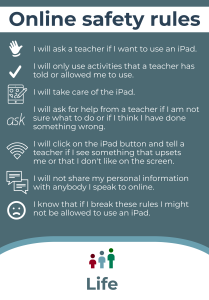
To help children use technology safely and responsibly, we have a set of simple online safety rules that are introduced from the very beginning of their time at Someries Infant School and Early Childhood Education Centre. These age-appropriate rules encourage pupils to use technology confidently while understanding how to keep themselves and others safe.
Children learn to use school devices only with an adult’s permission, follow their teacher’s instructions, take care of the equipment and ask for help whenever they are unsure or worried. They are also taught to tell a trusted adult immediately if they see something online that upsets them, makes them feel uncomfortable or does not seem right. Pupils learn never to share personal information online and understand that using technology safely and responsibly is an important part of being a member of our school community.
These simple rules are reinforced through our curriculum, assemblies and everyday classroom practice, helping children develop positive digital habits that will support them both in school and beyond.
NSPCC online safety guidance
CEOP's website for 4 to 7 year-olds
Jessie & Friends
Jessie & Friends is a series of engaging, age-appropriate online safety resources designed for children aged four to seven and their parents and carers.
Through animated stories, games and interactive activities, children learn how to stay safe when watching videos, chatting online, sharing pictures and playing games. The resources help children recognise situations that may make them feel worried, upset or uncomfortable, while reinforcing the importance of speaking to a trusted adult whenever something does not feel right.
The activities are tailored to different age groups, ensuring that key online safety messages are introduced in a way that is appropriate to children’s stage of development. Parents and carers are encouraged to explore the resources alongside their child, helping to start positive conversations about staying safe online and building good digital habits together.
Setting parental controls
We have included a range of practical guides to help you create a safer online experience for your child. These step-by-step resources explain how to set up parental controls, adjust privacy settings and manage safety features across popular devices, apps, games and online services. By using these tools alongside regular conversations about online safety, you can help your child enjoy technology confidently and responsibly.
Social Media
Technology is an important part of children’s lives, offering valuable opportunities to learn, create and communicate. As children spend more time online, it is important that they understand how to use technology safely, responsibly and respectfully.
At Someries Infant School and Early Childhood Education Centre, we work in partnership with parents and carers to help children develop the knowledge, skills and confidence they need to stay safe online. Together, we can help children recognise potential risks, protect their personal information, make positive choices online and know what to do if something makes them feel worried or uncomfortable.
Online risks continue to evolve and can include exposure to harmful content, inappropriate contact, unsafe online behaviour and online scams. By talking regularly with your child about their online experiences and encouraging open, honest conversations, you can help them develop the confidence to enjoy the benefits of technology while staying safe.
We are committed to supporting families by providing practical information, advice and guidance to help children build positive digital habits both at school and at home.