Developing the young musician at Someries Infant School and Early Childhood Education Centre
Music is a universal language that represents one of the highest forms of creativity. Through our music education, we engage and inspire children to develop a love of music and nurture their talent as musicians, boosting their self-confidence, creativity, and sense of achievement. As children progress, we guide them towards a critical engagement with music, enabling them to compose and to listen with discernment to some of the finest works in the musical canon.
Our music curriculum
At Someries Infant School and Early Childhood Education Centre, we believe that every child should experience the joy of music. Our carefully planned music curriculum enables pupils to develop as confident performers, thoughtful listeners and creative musicians, while fostering a lifelong appreciation of music from a wide range of cultures, traditions and genres.
From Nursery onwards, pupils benefit from high-quality music teaching delivered by specialist peripatetic music teachers through our long-established partnership with the Bedfordshire, Luton and Milton Keynes (BLMK) Music Hub. Music is an integral part of school life, with all pupils experiencing regular, progressive lessons that develop their singing, listening, composing and performing skills. Pupils attending our specialist Inclusion Bases also receive weekly music lessons delivered by a specialist peripatetic music teacher, who works closely with staff to adapt learning to meet individual needs. This ensures that music is inclusive, engaging and accessible for every pupil, enabling children with additional needs to participate meaningfully in music-making, develop their confidence and creativity, and experience the many benefits that music brings.
Singing lies at the heart of our music curriculum. Every pupil develops their vocal skills through regular classroom music lessons and weekly whole-school singing assemblies, where they learn an increasingly varied repertoire and experience the enjoyment of making music together as part of a larger ensemble.
Our curriculum also provides every child with the opportunity to learn to play an instrument. Throughout Key Stage One, pupils participate in whole-class instrumental learning, including recorder and ukulele tuition, enabling them to develop rhythmic accuracy, pitch awareness, coordination and ensemble performance skills while laying strong foundations for future instrumental study. Listening and musical appreciation are developed through dedicated weekly listening sessions using the Charanga Listening Centre. Pupils explore a rich and diverse range of musical styles, composers and traditions from around the world, broadening their cultural understanding while developing the vocabulary and confidence to discuss and respond to music.
Music extends well beyond the classroom through a wide range of enrichment opportunities. Each term, Key Stage One pupils participate in specialist music workshops, including African drumming and sound-scaping experiences, which encourage creativity, collaboration and musical exploration. Pupils can also extend their musical interests through our after-school Hobby School Music Programme, where they participate in vocal and instrumental ensembles and a variety of practical music-making activities. To ensure all pupils can benefit, fully funded places are available for disadvantaged children.
Performance is an important part of every child’s musical journey. Pupils perform regularly in weekly singing assemblies and annual Christmas concerts, celebrating their achievements with families and the wider school community. Year Two pupils also enjoy visiting Someries Junior School to experience live performances by older pupils, inspiring them to continue their musical development as they progress through their education.
By combining expert teaching, specialist workshops, instrumental learning, high-quality musical experiences and plentiful opportunities to perform, we ensure that every child develops the knowledge, skills, confidence and enthusiasm to enjoy music both now and throughout their lives.
Early childhood education curriculum milestones
Developing the knowledge and skills I need to be a successful young musician
The progress of pupils accessing our Early Childhood Education Centre is monitored using our unique curriculum milestone objectives to ensure they are suitably prepared with the foundational knowledge, skills and understanding they require to succeed in key stage one.
I explore a range of sound-makers and instruments and play them in different ways. I explore my voice and enjoy making sounds joining in with songs and rhymes.
I show attention to sounds and music and I also turn towards familiar sounds.
I play instruments with increasing control to express my feelings and ideas.
I can tap out simple repeated rhythms and explore and learn how sounds and movements can be changed.
I can sing the pitch of a tone sung by another person (‘pitch match’). I also listen with increased attention to sounds and show interest to noises.
I can explore and engage with music making and dance, performing solo or in groups. I also can sing in a group or on my own, increasingly matching the pitch and following the melody.
I can listen attentively, move to and talk about music, expressing my feelings and responses. I can listen carefully to rhymes and songs and pay attention to how I sound.
I can also learn rhymes, poems and songs.
I can sing a range of well-known nursery rhymes and songs, performing these as well as poems and stories with others and –when appropriate- try to move in time with music.
I also can make comments about what I have heard and ask questions to clarify my understanding.
Achieving these milestones throughout my early childhood education will support me in accessing my first steps in key stage one because they provide a foundation for me being able to:
- join in with singing songs, rhymes and chants with occasional actions and listen to music
- keep a pulse effectively and to copy back rhythms precisely, also to be able to control a dance scarf in response to listening to music
- play untuned percussion instruments and Boom whackers effectively and follow basic notation, holding a rhythm pattern with confidence
- demonstrate an awareness of the meaning of tempo and dynamics
Key stage one
How children will build on the foundational knowledge, skills and understanding they developed throughout their Early Childhood Education
Throughout key stage one, pupils are taught how use their voices expressively and creatively by singing songs and speaking chants and rhymes. They also learn how to play tuned and untuned instruments musically and how to listen with concentration and understanding to a range of high-quality live and recorded music. A wide variety of planned opportunities enable children to experiment with, create, select and combine sounds using the inter-related dimensions of music.
All pupils receive a weekly music lesson delivered by a specialist music teacher.
Instrumental tuition
All Year Two pupils receive whole-class instrumental tuition as part of our music curriculum.
Our instrumental tuition focuses on the recorder, bridging the gap between learning to play the flute.
This tuition enables all pupils to be well-prepared for the more formal instrumental lessons they will undertake as part of the Key Stage Two National Curriculum.
Recognition
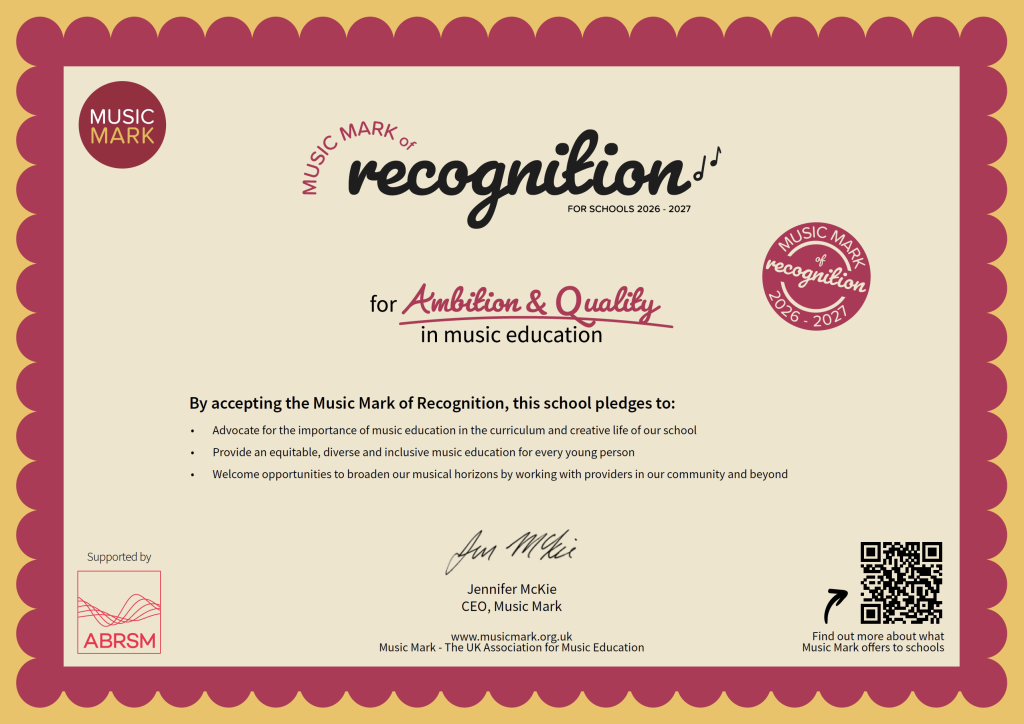
Music Mark of Recognition for Ambition and Quality in Music Education
Someries Infant School and Early Childhood Education Centre has been awarded the Music Mark of Recognition for Ambition and Quality in Music Education.
This award, presented by Music Mark – The UK Association for Music Education, celebrates the school’s commitment to ensuring that music plays a central role in enriching the learning and cultural experiences of all pupils.
By receiving this recognition, Someries Infant School and Early Childhood Education Centre affirms its dedication to promoting the importance of music education within both the curriculum and the wider creative life of the school. It is committed to providing an equitable, diverse, and inclusive music education, ensuring that every pupil has access to rich and meaningful musical experiences. The school also embraces opportunities to broaden its musical horizons by collaborating with music education providers in the community and beyond, strengthening its role as a high-quality provider of music education.
Saturday Music Centre
Saturday Music Centre is run by Luton Music Service every Saturday during term-time.
Mini Music sessions give children aged 5 to 8 the chance to take their first steps in music.